

If you’re looking into dental implants, you’re likely missing a tooth or have been told that you have a tooth that needs to be removed. Naturally, you have some questions. How do dental implants work? Are dental implants painful? How much is one dental implant? And how long can dental implants last?
Dental implants provide a uniquely stable and long-lasting tooth replacement option, as they integrate with the actual bone of the jaw, and act as a substitute for the root of your tooth.
In this guide, we’ll answer all of your questions and more, going into depth about how implants work, what they’re made of, what the procedure and recovery look like, what drives price, and how to choose the right oral surgeon to place them.
How Do Dental Implants Work?
A dental implant works by placing a small post in the jawbone where the root of your tooth once was and doing so in a way that allows the bone to fuse to the post, securing it in place. This process is called osseointegration and creates a stable platform for a replacement tooth to sit that looks, feels and functions like a normal tooth.
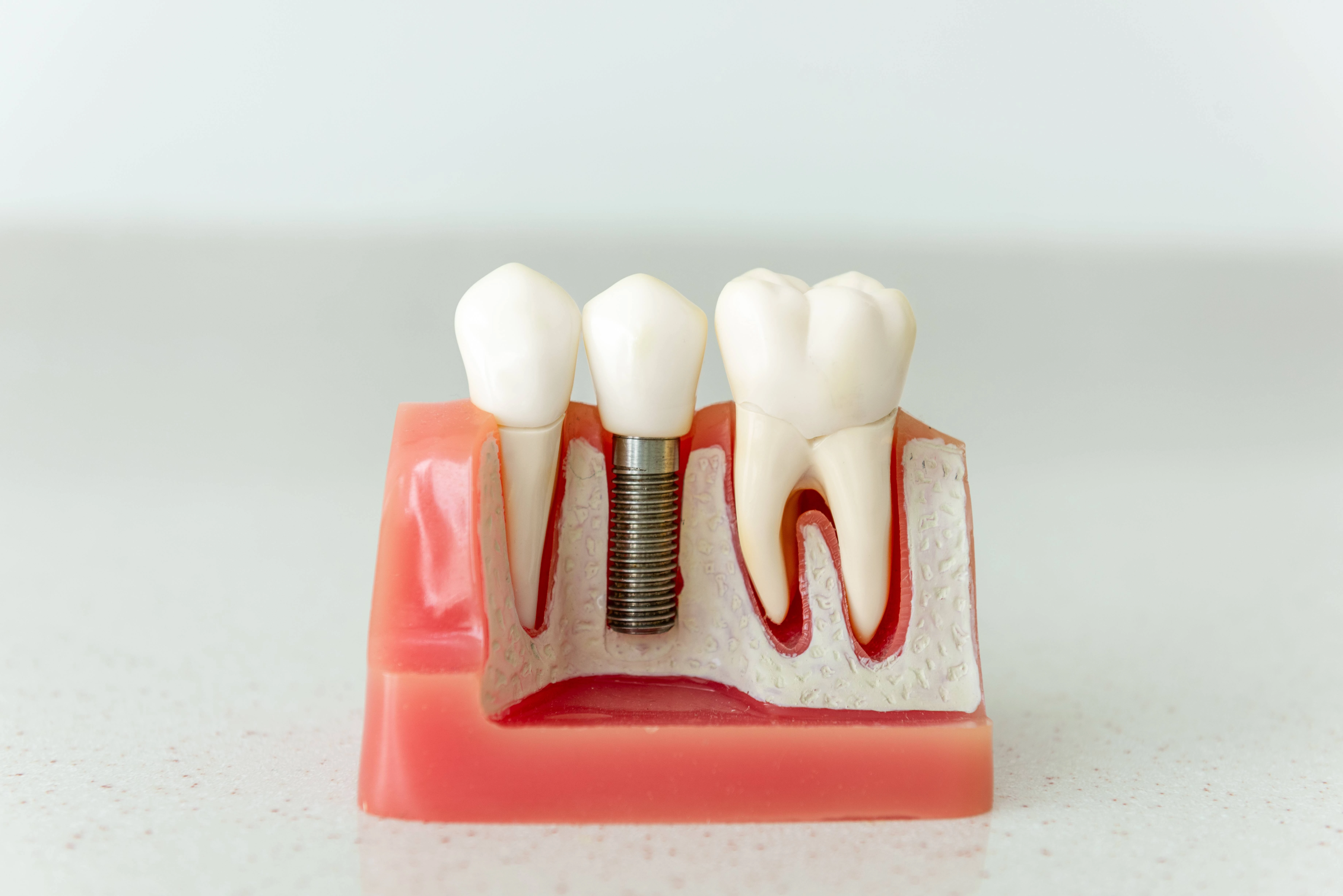
Many people are surprised to find that the answer to “how do dental implants work?” is actually quite simple. An implant consists of 3 components:
- The implant (or fixture): This is a small threaded post that is placed in the jawbone where your tooth’s root used to be. Through the process of osseointegration, it becomes fused to the jawbone.
- The abutment: This is a connector that attaches to the implant, passing through the gumline, and providing a place for the replacement tooth to latch onto.
- The crown: This is the visible part of the tooth that is secured by the abutment and is custom-made to match your smile and the surrounding teeth.
The magic of dental implants is in the body’s natural response to an implant being placed. Rather than treating an implant as a foreign object, the bone grows onto the surface, locking it into place through osseointegration.
A major benefit of dental implants that many people aren’t aware of is related to this process of osseointegration. When the root of your tooth is connected to your jawbone, it’s stimulating the bone, but when it’s gone, the bone can begin to deteriorate. Dental implants, by filling the space of the missing root, can help prevent bone loss.
What Are Dental Implants Made Of?
Dental implants are primarily made from two materials: titanium and zirconia. Both are biocompatible, meaning that your body will accept them and your bone will readily fuse to them. They are both safe and durable, but do have different characteristics that can make them suitable for different use cases.
Titanium Implants
- These have long been the gold standard: Titanium has been a trusted metal for decades with a long history of clinical success. It’s the same metal used in hip and knee replacements as well.
- They’re strong with a little bit of give: Titanium is an extremely strong material that’s also slightly flexible, which means that it can absorb forces without breaking. This is important when it comes to chewing, as molars can take on hundreds of pounds of pressure.
- The honest drawback: Titanium is a dark metal, and in cases with bone loss it can occasionally show as a faint grey line at the gumline. Dr. Seda accounts for this when planning, positioning the implant so that a grey line is unlikely to show even if bone loss occurs.
Zirconia
- Metal-free: Zirconia is a white ceramic, which can be a great alternative material for patients with metal allergies or sensitivities.
- Built to disappear: Because the material is ceramic, there isn’t a risk of a grey line under the gum. This is why it can be a desired choice for front teeth implants.
- The honest drawback: While zirconia is strong under pressure, it doesn’t have the same flexible properties as titanium, and is therefore more brittle. This is certainly a consideration for those who heavily grind their teeth and therefore would be putting extreme stress on the implant.
The materials of the other components:
Abutment
The abutment, which is the connector between the crown and the implant, is also made from either titanium or zirconia, and can be stock or custom-made for your case.
Crown
The crown is typically made from zirconia, other all-ceramic materials, or porcelain fused to metal.
So, if you’ve wondered what are dental implants made of, the truth is: it depends on the case. The right materials for the implant, abutment, and crown vary from person to person, because every situation is unique. For example, the right material for a molar might not be the right material for a front tooth, and a person who grinds their teeth may require a different plan than someone who doesn’t.
One thing that doesn’t vary is the importance of using a well-engineered implant system. They aren’t all created equal, as there are many companies producing them at meaningfully different levels of quality. The system your surgeon chooses affects everything from how the implant integrates with your bone to whether you’ll still easily be able to find replacement parts decades down the line. Dr. Seda closely follows advancements in implant technology and places systems from established manufacturers he trusts to deliver predictable long-term outcomes.
Are Dental Implants Painful?
For most people, dental implants aren’t painful, which can come as a bit of a surprise. The procedure itself is done with local anesthesia, so you shouldn’t feel pain while the implant is being placed. If anything, you’ll just feel pressure and vibrations.
To put your mind at ease, in case you’re someone who’s been making late night Google searches of how painful are dental implants, here’s what a typical dental implant procedure looks like at Seda Oral Surgery from a comfort perspective:
Every procedure starts off with local anesthesia, and numbing jelly is applied to the gums before you ever feel a needle. From here, nitrous oxide is provided if you want it, and if you’re medically fit, IV sedation can also be an option. Many patients are relaxed enough during the procedure that some even fall asleep.
After the procedure, discomfort can depend on your specific case. Most patients will experience soreness that peaks in the first day or two, but it’s usually well managed with non-narcotic medication such as prescription-strength Tylenol and Advil as directed by your surgeon. To put it into perspective, the implant placement is typically less uncomfortable than the extraction that preceded it and many patients are back to work the next day.
So, is a dental implant painful? The procedure shouldn’t be and the recovery is usually quite manageable. For most patients, the worst part of the whole thing isn’t the actual procedure, but simply the anticipation. If you’re experiencing pain that continues to increase around day 3 of your recovery, that’s not normal, and is when you should give us a call so we can figure out what’s going on.
Are Dental Implants Safe?
Dental implants are some of the most predictable procedures in dentistry and there’s plenty of research that backs this up. A meta-analysis published in the Journal of Dentistry, reviewed 18 prospective studies and found that on average implants have a ten-year survival rate of 96.4%, with the same review putting the more conservative estimate closer to 93%. Either way, the common figure of 95% that most patients hear holds up well against the literature. In other words, roughly 95 out of 100 implants are still in place and functioning a decade later.
That said, are dental implants safe for everyone, in every case, with no risks? Well, technically no surgery can achieve that level of certainty, and we certainly won’t pretend that implants are any different. The risks are mainly infection at the implant site, an implant failing to integrate with the bone, and, rarely, irritation of a nerve or sinus.
But the good news is that there are plenty of things that can be done to manage those risks:
- An honest and thorough health history. Conditions like uncontrolled diabetes and habits like smoking can lower success rates.
- 3D imaging paired with a precise plan. By understanding a person’s anatomy and planning the implant in such a way that it avoids nerves and sinus cavities, those complications can be avoided from the start.
- Your oral surgeon’s technique. An experienced and skilled surgeon can mitigate risks during surgery. Sometimes things will happen that are unexpected and out of a surgeon’s control, in which case a surgeon who can adapt and rely on their background to navigate a unique situation is key.
How Long Do Dental Implants Last?
The implant post can last decades, often for the rest of your life. The part of the implant that wears and could need to be repaired or replaced with time is the crown. Because of this, when thinking about how long can dental implants last, it’s important to not lump all of the pieces of the implant system together.
However, even with that being the case, the data suggests that crowns still have a high survival rate. A systematic review published in Clinical Oral Implants Research found that implants supporting single crowns survived at about 95% after ten years, while the crowns themselves survived at about 89%. So while the survival rate of crowns is slightly lower than that of implants, it’s still excellent, and shows just how durable and long-lasting implants can be with the right care.
As further reassurance, when something does go wrong with a crown, it’s usually a repair, rather than a replacement. Some examples of repairs include a loosened screw, which can get retightened in a single visit, or a chipped crown. A common cause of chipping is grinding, so if you grind your teeth, Dr. Seda may recommend you wear a night guard when you sleep.
Your own habits have a real impact on your implant’s longevity. Brushing and flossing the implant like it’s a natural tooth, keeping up with regular dental cleanings, as well as not smoking, can all help extend the lifetime of your implant.
How Do Implants Compare to a Bridge?
If you’ve been weighing dental implants vs dental bridges, the main difference is how they’re anchored: a bridge attaches to the neighboring teeth for stability while a dental implant stands on its own, getting its stability through the jawbone.
Let’s break down the impacts of that functional difference:
Health of the Jawbone
A major benefit of a dental implant is that because the implant replaces the root, the jawbonearound the implant is kept stimulated. The bridge on the other hand isn’t anchored into thejawbone, and because of this the jawbone begins to shrink in the space where the tooth’s rootonce was. This can cause neighboring teeth to shift, and it can even change your facialappearance
Cleaning
When it comes to day to day cleaning, an implant is cleaned like a normal tooth. Meanwhile, a bridge is more difficult to clean, requiring floss threaders to clean underneath the bridge. If cleaning isn’t diligently maintained, neighboring anchor teeth can decay.
Longevity
Because a bridge depends on the two teeth supporting it, a problem with either one means the whole bridge has to be redone. Bridges typically get replaced more often than implants, so while bridges may be cheaper upfront, there’s the long-term added cost of replacements.
There are still cases where a bridge makes the most sense, like when surgery isn’t a good fit for someone’s health or timeline, or when neighboring teeth already need crowns for their own reasons. A bridge is also faster, since you don’t need to wait for the bone to fuse.
Ultimately, the right decision comes down to a range of factors that your oral surgeon will be able to help you navigate with the help of imaging and a proper evaluation of your mouth.
How Long Does Getting a Dental Implant Take?
Most single-implant cases from start to finish take 2 to 7 months, assuming the tooth has already been removed. This surprises people, as many go searching for how long do dental implants take and expect the answer to be closer to weeks than months. However, the reason doesn't have anything to do with scheduling or lengthy procedures. It’s simply a matter of biology.
Here’s the process of dental implants at Seda Oral Surgery, step by step:
STEP 1: Consultation and 3D Imaging
Dr. Seda starts with advanced imaging including a 3D CBCT scan that he uses to evaluate your bone and map all of the nerves and sinuses. He then digitally plans the implant’s position and size, virtually simulating the surgery before it ever happens. If bone is minimal, custom surgical guides are made to ensure placement is precise and controlled.
Side note: If you don’t have enough bone volume for an implant, you may need a bone graft, which essentially builds a proper foundation for the implant, and is a process that can help make implants possible for people who were told they weren’t candidates. While this adds months to the timeline, it can be a necessary step for ensuring your implant is effective long-term.
STEP 2: Implant Placement
The surgery itself is shorter than most people expect, with a single implant often taking under an hour. Following the procedure, you’ll want to plan on soft foods for a few days and take it easy the rest of the day.
If the implant has good primary stability when it’s placed, meaning a strong torque value when it goes in, then Dr. Seda can place a healing abutment at the same time. A healing abutment is a temporary piece that sits on top of the implant and shapes the gum tissue around it so that the crown can sit comfortably and naturally. In some cases, a custom temporary can be made that’s shaped to resemble a natural tooth, set in such a way that it’s out of your bite in order to avoid any chewing forces being placed on the implant while it heals. For the right candidate, that temporary can sometimes be made the same day as the procedure.
STEP 3: Osseointegration
This is the long stretch that creates the multi-month timeline. This is the stage where your bone fuses to the implant and typically takes anywhere from 8 weeks to 6 months. Advanced implant systems like the ones we use in our office can integrate on the faster end of that range when the surrounding bone is healthy. During this process you’ll simply go about your life as usual.
STEP 4: Abutment and Final Impressions
If a healing abutment wasn’t placed at the time of surgery, it goes on once the implant has integrated with the bone. And it stays in place for about two weeks so the gum tissue can get shaped in a way that accommodates the crown. After the gum tissue has healed around the healing abutment, an impression or digital scan is taken so your crown can be custom crafted to fit the space.
STEP 5: Final Crown
At this stage, the final abutment, which is the permanent connector that holds your crown, is placed along with the crown itself. Your custom crown is checked against your bite and at this point, the tooth is complete.
STEP 6: Follow Ups
Complimentary follow-up visits are included, so Dr. Seda can make sure your healing is on track.
How Long Do Dental Implants Take to Heal?
If you’re wondering how long do dental implants take to heal, there are a few different healing timelines happening simultaneously. In terms of discomfort, most patients feel better within about a week. On the soft tissue front, the tissue around the surgical site can close within a few days if no healing abutment is placed, or can take around two weeks if there is one present. The bone is the slowest to heal, with integration taking 8 weeks to 6 months. This can also run longer if you need a bone graft beforehand or if there are other conditions slowing the process down like a lower bone quality, an unmanaged health condition, or smoking.
Some swelling and minor bruising is expected in the first few days after the procedure, but if pain continues to increase after day 3 or you’re experiencing a fever or numbness that doesn't fade, it’s important to call us ASAP.
What Do Dental Implants Cost?
There isn’t a single number that answers the question of how much dental implants cost, because the materials of the implant system and the complexity of your case both add variability to the equation.
Materials
Implant systems are broken down into 3 components: the implant itself, the abutment, and the crown. As we covered in the section about what dental implants are made of, the materials vary, and which ones make sense depends on your specific case. These material decisions create a range of costs. For example, a custom-milled abutment costs more than a stock one, and the cost of a front tooth crown can be different from a molar crown, since the demands on each aren’t the same.
Complexity
No two cases are the same. A straightforward implant into healthy bone is going to carry a different cost than a case where a tooth needs to be extracted first or where the tooth has been missing for a while and the jawbone has shrunk.
This is why, if you’ve searched how much is one dental implant, the ranges were probably uselessly wide. Imaging and a proper evaluation by an oral surgeon are the only ways to truly know how much a dental implant is going to cost.
It’s important to be wary of the cheapest quote, because a much lower number can mean off-brand components that are more difficult to service later on, or a case complexity that hasn't been diagnosed yet.
The implant itself is a real part of that. Quality and cost vary significantly between implant systems, and at Seda Oral Surgery we use premium implants rather than cutting corners on the component that has to last you decades.
The most important questions to ask when receiving a quote:
- What system is being placed?
- What’s included in the cost of treatment?
- Who handles it if something needs attention down the road?
At Seda Oral Surgery, we believe in the importance of transparency and break down the cost of treatment for you as clearly as possible so you know what you’re looking at before you commit. We also have a team that has expertise in maximizing insurance reimbursement and will walk you through financing options before anything is scheduled.
Who Should Place Your Dental Implant?
There are several different types of dental professionals who can do dental implants, but it’s important to consider that the amount of implant-specific training varies quite a bit between them.
General Dentists
In most states, any licensed dentist can legally place a dental implant. No specialty certification required. While a general dentist could have pursued continuing education in implant placement, and could do an effective job, there’s no standardized requirement, so the depth of that training varies from one dentist to another.
Prosthodontists
Prosthodontists do a 3 year residency after dental school that focuses on restoration. Many place implants, but their depth of knowledge is in planning and final restoration.
Periodontists
Periodontists can also place implants and complete a 3 year residency following dental school that centers on the gums and the bone that supports your teeth. Implant placement and bone grafting are a core piece of their training and they are specialists in this area.
Oral and Maxillofacial Surgeons
Oral and maxillofacial surgeons complete a 4 to 6 year hospital-based surgical residency that covers implant placement, bone grafting, anesthesia administration, and managing surgical complications when a case doesn’t go as planned.
When people search for a dental implants specialist, lots of different specialties will pop up, and for a straightforward implant, an experienced provider from any of these backgrounds can deliver a good result.
However, for more complex cases, an oral surgeon’s extensive surgical background can give them a unique advantage for navigating things like thin bone, previously failed implants, sinus and nerve involvement, and medically complex health histories.
Whoever you choose, make sure you ask questions like: How many implants do you place a year? What implant system do you use? What are your anesthesia credentials? Who handles it if something needs attention down the road?
When it comes to Dr. Justin Seda’s credentials, he’s a board-certified oral and maxillofacial surgeon. He earned his DDS at Columbia University’s College of Dental Medicine, going on to complete his surgical residency at the University of Miami’s Jackson Memorial Hospital and the Miami Bruce W. Carter Veterans Affairs Medical Center. He had the honor of being Chief Resident. He is affiliated with and holds hospital privileges at New York Presbyterian Cornell Hospital, Lenox Hill Hospital, and Mount Sinai Hospital.
While credentials aren’t everything, they’re a great place to start for verifying you’re in good hands before you sit in the chair.
Frequently Asked Questions
Am I too old for dental implants?
There’s no upper age for dental implants. What actually matters is the state of your jaw bone and overall health. Plenty of implant patients are well into their seventies and eighties. In fact, a 2025 review in Clinical Oral Implants Research found implants to be a reliable option for older adults, including patients over 75, with the bone around the implants staying stable over time.
Can I still get an implant if the tooth has been missing for years?
Usually, yes. Bone does shrink in the area where you lost your tooth, but solutions like bone grafting can help rebuild a stable foundation. An evaluation will give you a definitive answer, as 3D imaging can reveal the state of your jawbone.
Do dental implants feel like real teeth?
Dental implants feel very close to real teeth, where chewing and speaking feel natural. In fact, most patients stop thinking about which tooth is the implant rather quickly. The one area where it does feel different is the tooth’s sensitivity to hot or cold. This is because the implant doesn’t have a nerve to register these sensations.
What happens if a dental implant fails?
Implant failure is uncommon, and if it does happen then it’s usually early in the process, before the crown is placed. When it happens, the implant is removed, the site is left to heal, sometimes with the help of a graft, and then once it’s healed a new implant can be placed. It’s not considered an implant failure when a screw loosens over time or an implant chips, as these are typically repairs.
What if I need to replace a full arch of teeth?
If you need to replace an entire arch of teeth then All-on-X is a great solution. The treatment replaces an entire arch on as few as four implants, often allowing you to leave with a temporary set the same day as your procedure. You can read more about this process on our All-on-X treatment page.
Final Thoughts on Dental Implants
A dental implant provides a unique replacement for your tooth, because it integrates with the jawbone. This helps the bone stay stimulated and healthy and is why the timeline is measured in months rather than weeks. It’s also why the result is so stable, leading to a survival rate of around 95% after 10 years. The price of dental implants depends on the materials and complexity of your case more than anything else, and the person who you choose to place it matters.
At Seda Oral Surgery, Dr. Seda plans every implant digitally using 3D imaging, before using his extensive oral surgery background to place the implant with precision. He follows your healing process personally through complimentary follow-up visits and is truly one call away if you need anything.
The questions that this guide couldn’t answer like what your specific case will cost, whether you’ll need a graft first, and what your actual timeline looks like, are all questions that can be answered during an initial consultation. So if you’re looking for dental implants in NYC and want to better understand your situation, don’t hesitate to reach out to us at Seda Oral Surgery here in Manhattan.
Sources
1. Howe MS, Keys W, Richards D. Long-term (10-year) dental implant survival: A systematic review and sensitivity meta-analysis. Journal of Dentistry. 2019;84:9-21. https://doi.org/10.1016/j.jdent.2019.03.008
2. Jung RE, Zembic A, Pjetursson BE, Zwahlen M, Thoma DS. Systematic review of the survival rate and the incidence of biological, technical, and aesthetic complications of single crowns on implants. Clinical Oral Implants Research. 2012. https://pubmed.ncbi.nlm.nih.gov/23062124/
3. Abou-Ayash S, Bjelopavlovic M, Molinero-Mourelle P, Schimmel M. Implant Survival in Patient Populations With a Mean Age of 65-75 Years Compared to Older Cohorts: A Systematic Review and Meta-Analysis. Clinical Oral Implants Research. 2025. https://doi.org/10.1111/clr.14456